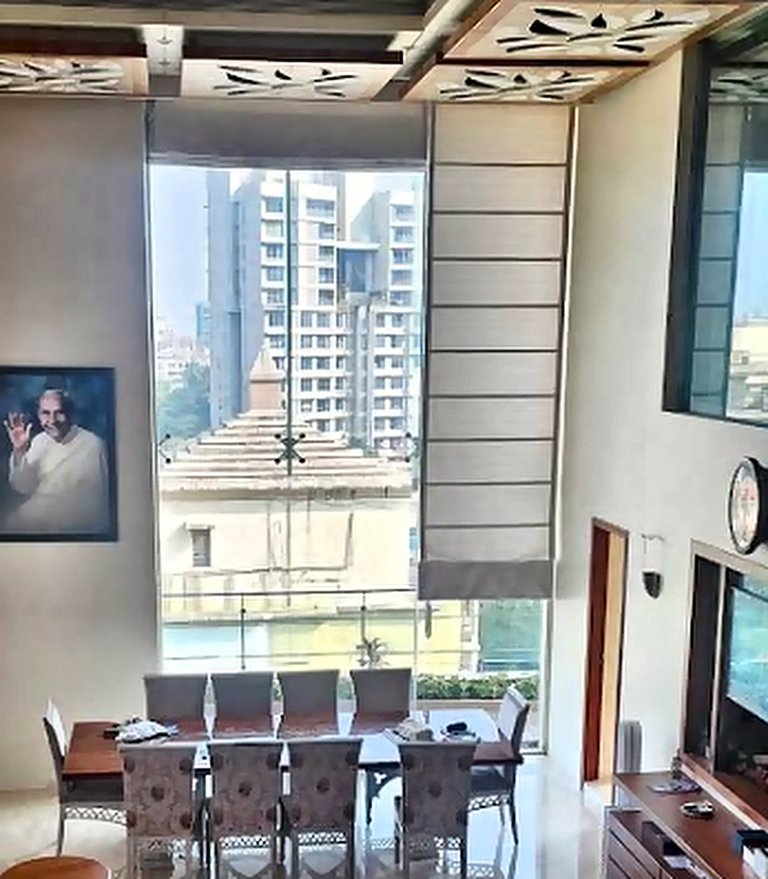
Customers usually arrive having already decided — and about a third of them change their minds once they see the two options side by side against a real window. The right answer depends on the room, not on taste.
The short version: curtains are warmer, quieter and better at blocking light; blinds are neater, cheaper for small windows and better where space is tight or the window gets wet.
Cost: blinds win on small windows, curtains on big ones
Blinds are priced per square foot, curtains by fabric metre plus stitching. That single difference decides most budgets.
| Window | Roller blind | Lined curtains |
|---|---|---|
| Small (3 ft × 4 ft) | ₹1,100 – ₹3,000 | ₹3,500 – ₹8,000 |
| Standard (5 ft × 7 ft) | ₹3,200 – ₹8,700 | ₹6,500 – ₹18,000 |
| Large (8 ft × 8 ft) | ₹5,800 – ₹16,000 | ₹12,000 – ₹35,000 |
For a small kitchen or bathroom window, a blind is obviously cheaper. For a full living-room wall of glass, the gap narrows, and curtains often look better for the money.
Light control and heat
A blackout curtain with a three-pass lining is the only thing that genuinely darkens a room, because fabric overlaps the frame on all sides. Even a blackout roller blind leaves light halos down the edges unless it is fitted with side channels.
Blinds win on adjustability: venetian and zebra blinds let you tilt or slide to keep the view while killing the glare, which curtains cannot do — they are open or closed.
For heat, layered curtains are better insulators. On a top-floor Mumbai flat, lined curtains make a measurable difference to how quickly a room cools.
Privacy, especially at night
This is where people get caught out. Sheer curtains and light-filtering blinds both look private during the day and become transparent after dark once the lights are on inside.
If your window faces a walkway, an opposite building or a society compound — common in Goregaon, Malad and Andheri — you need either a dim-out blind or a layered curtain arrangement: sheer for the day, heavier panel for the night.
Dust and maintenance in Indian cities
- Curtains hold dust in the fabric but you can take them down and wash or dry-clean them once or twice a year.
- Venetian blinds collect dust on every slat and need wiping, which is genuinely tedious on a wide window.
- Roller and zebra blinds are the easiest: a wipe with a damp cloth handles most of it.
- Roman blinds sit in between — fabric folds trap some dust but the surface area is small.
On a main-road flat, roller blinds plus a washable sheer is the lowest-maintenance combination we recommend.
Which to choose, room by room
| Room | Best choice | Why |
|---|---|---|
| Master bedroom | Blackout curtains | Only fabric truly darkens the room |
| Living room | Sheers plus curtains, or Roman blinds | Layering handles day and night |
| Kitchen | Roller or vinyl blind | Wipe-clean, no grease absorption |
| Study / home office | Zebra or venetian blind | Glare control without losing the view |
| Children’s room | Curtains with cordless blind | Safety — avoid looped cords |
| Balcony | Outdoor blind or bamboo chick | Handles rain and sun |
| Office | Vertical or roller blinds | Cost per square foot at scale |
The answer is often both
The arrangement that satisfies most households: a roller or Roman blind fitted inside the recess for daytime glare and privacy, with a light curtain on a track outside the recess for softness and night-time coverage.
It costs more than either option alone, but it solves every scenario — morning sun, evening privacy, guests, afternoon naps — and it is what we install most often in 2 and 3 BHK flats.
The verdict
Choose blinds if the window is small, wet, or in a room where you want the view preserved and cleaning kept simple.
Choose curtains if the room is for sleeping, if you want warmth and softness, or if the window is large enough that a blind would look like an office.
Either way, measure carefully first — see our measurement guide — and see both options in daylight before deciding. Everything discussed here is on display at our Goregaon West showroom.
Not sure which suits your window? Send a photo on WhatsApp with the approximate size. We will tell you what we would fit in our own home, and what it would cost either way.
