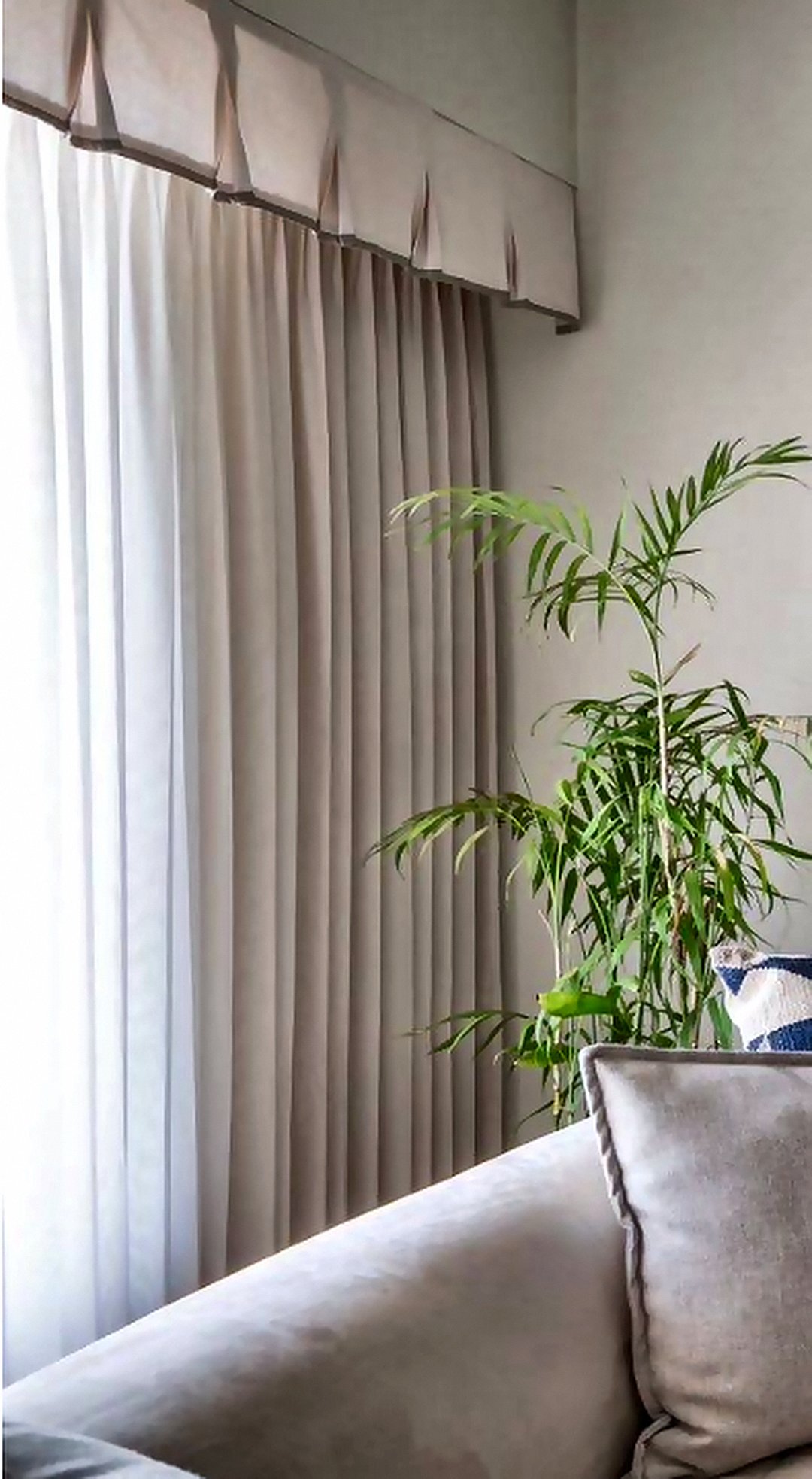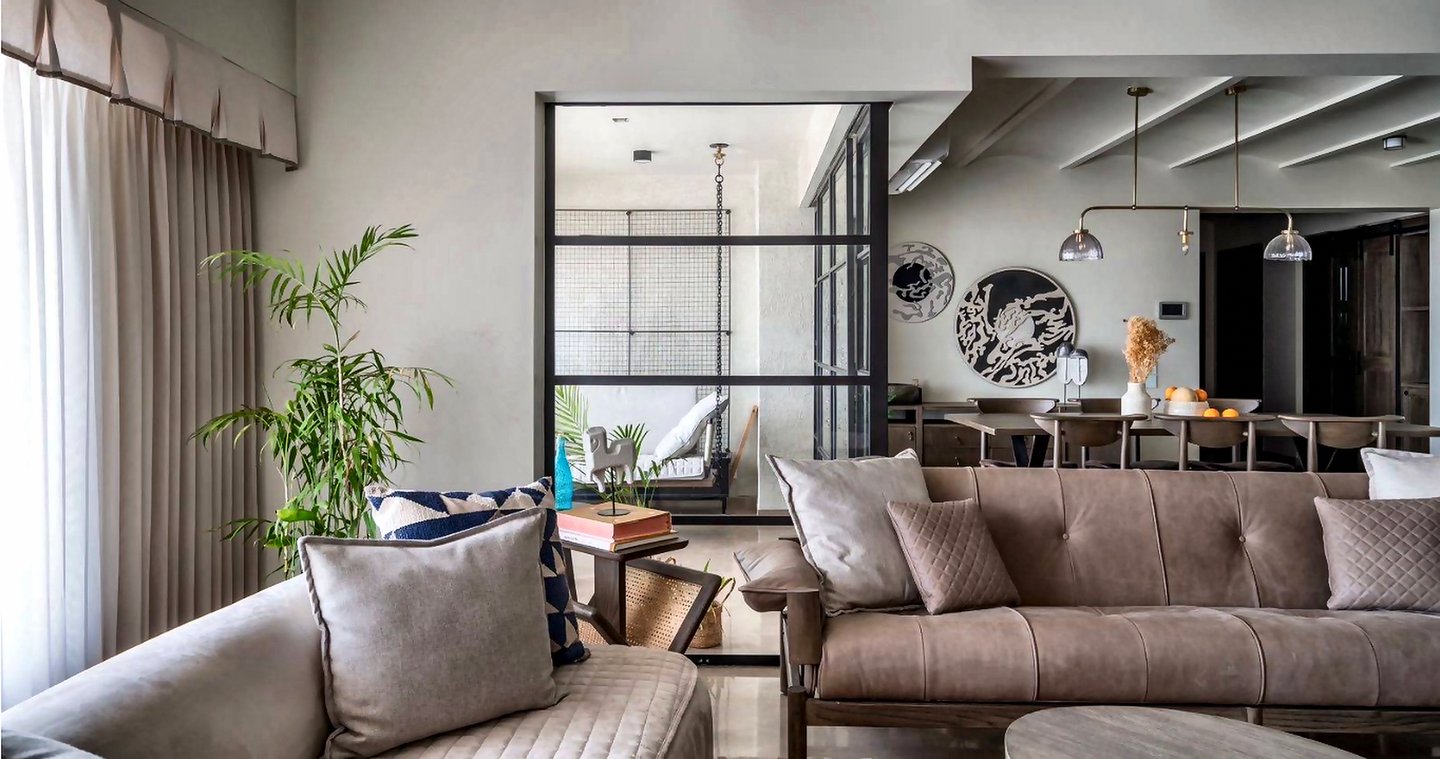
Almost every curtain complaint we hear in the showroom traces back to one of four decisions made in the wrong order: the fabric was chosen first, the lining was skipped, the heading was picked from a photo, and the drop was measured casually. Reverse that order and the result looks completely different.
This guide is written from what we see in Goregaon, Malad, Andheri and Jogeshwari flats every week — not from a global style manual. Mumbai has its own conditions: brutal west light, nine months of humidity, monsoon splash, construction dust and windows that are rarely the size anyone expects.
Start with what the room needs, not the fabric
Before you look at a single swatch, answer three questions about the room.
- How much light do you want at 3 pm? A north-facing study can take sheers alone. A west-facing bedroom in Goregaon needs a blackout or you will be awake at sunrise and cooking by evening.
- Who uses the room? Children and cats mean washable fabric and no floor-puddling hems.
- Does the window open for air? If you rely on cross-ventilation, heavy jacquards on a rod will annoy you daily. Choose a lighter fabric or a blind that stacks clear of the opening.
Only after those answers does fabric selection become quick, because two-thirds of the options in any showroom disqualify themselves immediately.
Fabric weight and weave: what survives Mumbai
Humidity and UV are the enemies. Delicate pure silks and loose linens look wonderful in a catalogue photographed in Europe; in a Mumbai flat they sag on the rod within a season and fade unevenly where the sun hits.
What holds up: tightly woven polyester blends, cotton-poly mixes, jacquards, chenille-backed drapes, velvets in air-conditioned rooms, and solution-dyed fabrics where colour is locked into the fibre rather than printed on.
| Fabric | Fade resistance | Humidity behaviour | Verdict |
|---|---|---|---|
| Polyester blend | High | Stable, no shrinkage | Best all-round choice |
| Cotton | Medium | Can shrink 2–3% | Pre-shrunk only |
| Jacquard | High | Very stable | Formal rooms |
| Velvet | High | Holds moisture, needs airflow | AC bedrooms |
| Pure linen | Low–medium | Relaxes and creases | Only if you like the look of creases |
| Pure silk | Low | Sun-rots without lining | Avoid on sunny windows |
A practical test in the showroom: hold the fabric up to the door and look through it towards daylight. What you see is exactly what you will get at 4 pm in your living room — far more honest than any product description.
Linings do more work than the fabric
Lining is the cheapest upgrade in the entire order and the one people skip most often. It changes four things at once: light control, heat, drape and how long the face fabric lasts.
- Dim-out lining softens light and adds body. Right for most living rooms.
- Three-pass blackout blocks around 99% of light and noticeably reduces heat gain on west windows. Essential in bedrooms and nurseries.
- Thermal lining helps in top-floor flats where the slab radiates heat until midnight.
- No lining is a legitimate choice only for sheers and balcony screens.
An unlined curtain on a sunny window will fade along its leading edge within about two years. A lined one protects itself.
Heading styles, and which suits which window
The heading is the top of the curtain — how it gathers. It sets the entire personality of the window.
| Heading | Fullness needed | Looks | Works on |
|---|---|---|---|
| Pinch pleat | 2.0–2.5× | Tailored, formal | Track or rod |
| Eyelet | 1.8–2.0× | Casual, wavy | Rod only |
| S-fold / ripple | 2.0× | Modern, uniform | Special track |
| Pencil pleat | 2.5–3.0× | Traditional, gathered | Track or rod |
| Tab top | 1.5–1.8× | Relaxed, informal | Rod, light fabric |
For a tall living-room window, S-fold on a ceiling-mounted track gives the cleanest result. For bedrooms, pinch pleat with blackout lining is still the most reliable combination.
Length and width: the two most common mistakes
Mistake one: hanging the rod at the window frame. Fix the track 4 to 6 inches above the frame — or at the ceiling if the slab allows — and extend it 6 to 10 inches beyond the frame on each side. The window instantly reads bigger and light stops leaking around the edges.
Mistake two: a short drop. Curtains should either kiss the floor (about half an inch clear) or break gently on it. A curtain ending mid-wall makes a nine-foot ceiling look eight.
The fabric quantity follows from those two numbers: track width × fullness multiplier, divided by fabric width, then multiplied by the drop plus hem allowance. Our step-by-step measurement guide works through a real example with numbers.
Choosing a colour you will still like in three years
Take your cue from the largest fixed surface in the room — usually the floor or the sofa. Curtains that sit one or two tones away from the wall colour make a room feel calm and taller; curtains in a hard contrast turn the window into the loudest object in the room, which is fine only if you want that.
Practical notes for this city: very pale solids show dust from the road within weeks on a main-road flat like New Link Road; very dark solids show lint and cat hair. Mid-tone textures — sand, taupe, caramel, olive, muted teal — hide both and photograph well.
If the sofa is patterned, keep the curtains plain. If the sofa is plain, a subtle textured weave in the curtain adds the interest the room is missing. This is also the moment to think about sofa fabric, because matching later is much harder.
Care and cleaning in a humid city
- Vacuum the header and hem every month with a brush attachment — that is where the dust settles.
- Wash blended sheers at 30°C on a gentle cycle and hang them back damp; they drop out their own creases.
- Send lined, jacquard and velvet curtains for dry cleaning once a year, ideally just before the monsoon.
- Open windows during dry spells. Curtains that stay shut in a closed, humid room develop that musty smell people blame on the fabric.
- If a hem gets splashed during heavy rain, dry it flat rather than leaving it against the wall, which is how mildew marks start.
A realistic budget checklist
For one standard 5 ft × 7 ft bedroom window, done properly, plan for:
- Face fabric — 6 to 7 metres
- Blackout lining — the same quantity
- Stitching for a lined pair
- Track or rod plus brackets
- Installation
Current indicative ranges for each of these are listed on our curtains and blinds page. Budget once, buy lining, and you will not be re-doing the window in two years.
Bring a photo of the room and rough window sizes to the showroom on New Link Road. We will shortlist three fabrics that suit your light, quote them with and without lining, and measure at home free of charge.